How to cross Estonia-Russia border by bus in 2026
Updated: September 2026
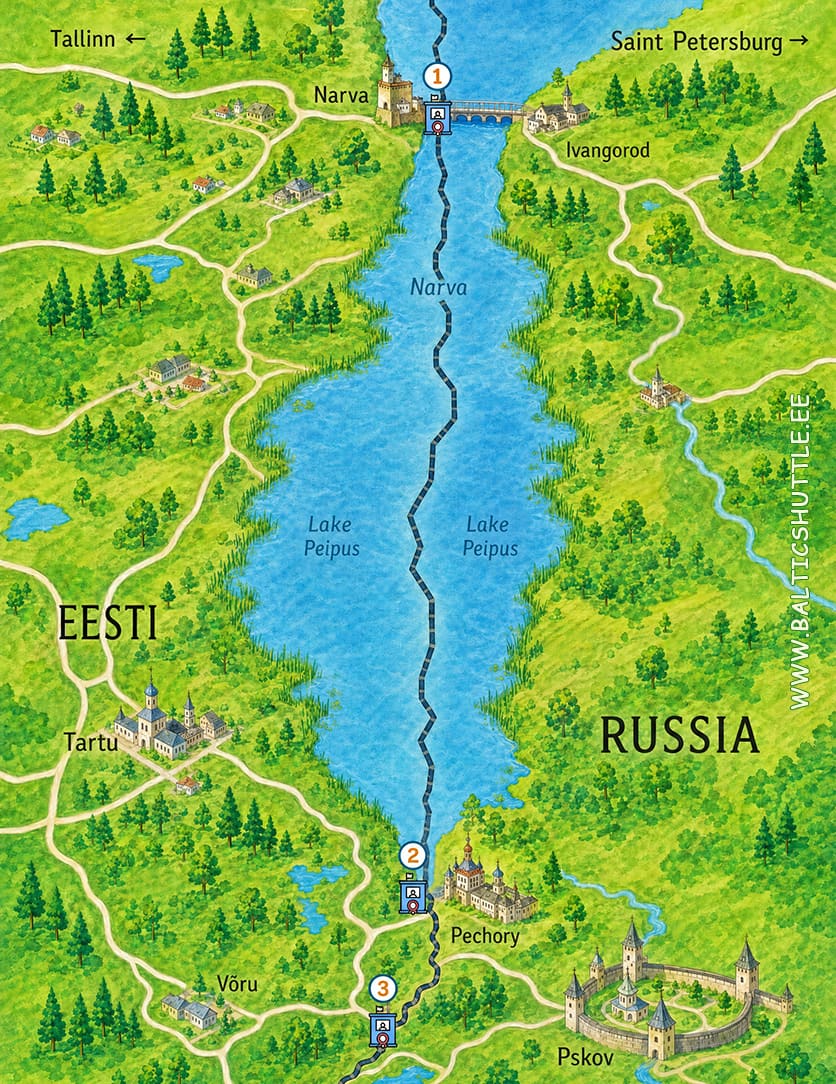
Baltic Shuttle operates daily bus service from Estonia to Russia via the Tallinn — St Petersburg route (through the Narva → Ivangorod border crossing) and the Tallinn — Pskov route (through the Koidula → Kunichina Gora border crossing).
- The Tallinn — St Petersburg bus route is operated using two separate buses, with passengers crossing the border on foot from Narva to Ivangorod.
- The Tallinn — Pskov bus route is operated on a single bus, as the Koidula and Kunichina Gora checkpoints remain open to vehicle traffic.
Note: Since June 15, 2026, all Estonian border checkpoints have transitioned to a 9:00 AM to 7:00 PM (09:00 to 19:00) operating schedule.
Tallinn — St Petersburg bus service
Daily Baltic Shuttle bus runs from Tallinn to St Petersburg via Narva are operated three times a day: at 00:40, 06:50, and 09:45 (a detailed schedule is available on the route page). These trips are run jointly with the Russian carrier SKSauto. The ticket price includes the entire journey from Tallinn to St Petersburg.
The estimated travel time from Tallinn to St Petersburg is approximately seven and a half hours, but this depends on the time required to complete border and customs control procedures.
Buy a Tallinn — St Petersburg bus ticket online
Since vehicle traffic through Narva—Ivangorod is suspended, the Baltic Shuttle bus takes passengers to Peter's Square (Peetri plats) in Narva. From there, passengers undergo border clearance at the Narva-1 checkpoint, walk across the bridge to the Russian side on foot, pass border and customs control at the Ivangorod checkpoint, and then board the waiting SKSauto bus.
Detailed information on passing through the Narva → Ivangorod border crossing is available on the Tallinn — St Petersburg bus route page.
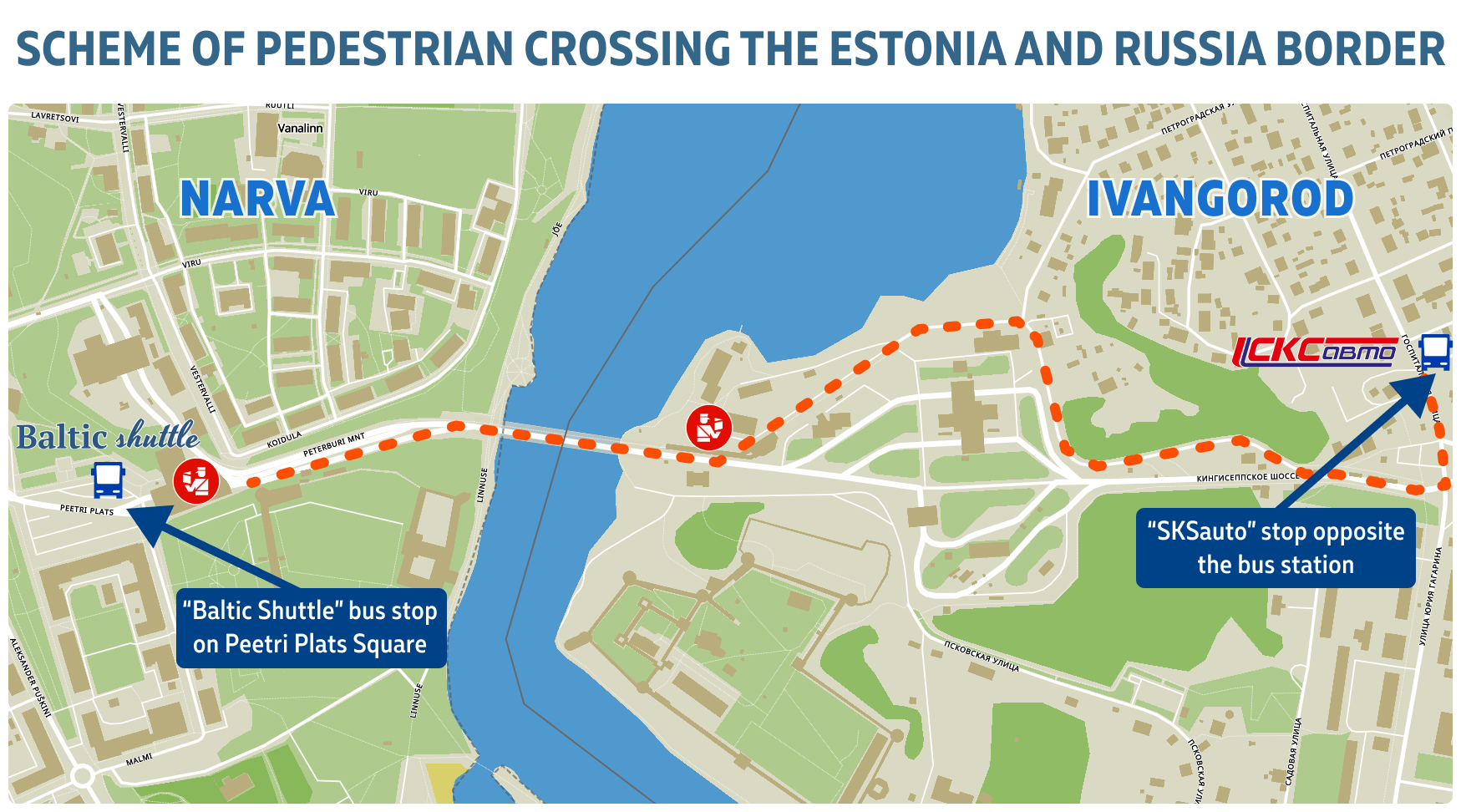
Important points of crossing the border in Narva
Please note that significant delays may occur during border and customs control procedures, which in turn can delay the bus's arrival in St Petersburg.
- The time needed to cross the border from Narva to Ivangorod varies greatly depending on the number of people crossing the border on any given day and the specific shifts of border guards and customs officers on duty at the Narva-1 checkpoint.
- After the pedestrian border crossing, buses wait for passengers to board for approximately two hours, or longer in case of long queues at border control and the delayed arrival of most passengers (the driver manages this based on the current situation).
- Under a mutual agreement between the bus operators, they accommodate each other’s passengers if they are late for boarding due to queues or long border clearance times. Drivers or dispatchers contact delayed passengers using the phone number provided at the time of ticket purchase. For this reason, it is essential to provide a valid mobile phone number, keep your phone turned on, and answer incoming calls.
- The queue situation at the Narva-1 checkpoint can be monitored in real-time via webcams on the Baltic Live Cam service.
Tallinn — Pskov bus service
Baltic Shuttle operates a daily bus run from Tallinn to Pskov on the Tallinn — Tartu — Värska — Pechory — Pskov route. The travel time from Tallinn to Pskov by bus is approximately eight hours; however, this is subject to border and customs clearance times.
The Tallinn — Pskov bus schedule and detailed information about this service are available on the route page.
- Bus passengers have priority at border control over those crossing the border on foot.
- On this route, the overall border crossing duration is directly related to the number of passengers selected for individual interviews at the Kunichina Gora checkpoint. All passengers with non-Russian passports are interviewed at this border crossing.
Buy a Tallinn — Pskov bus ticket online
How to speed up border crossing
To clear border and customs control without unnecessary delays, you must strictly comply with customs regulations, sanctions, and other restrictions.
- The European Union has completely banned the export of any banknotes of EU countries (euros, Polish zlotys, Czech korunas, Hungarian forints, etc.) to Russia. Carrying euro banknotes is prohibited, even for personal use. Only a small amount of coins is permitted. Information regarding currency exchange offices near the Narva-1 checkpoint and in Tallinn, where you can exchange euros for rubles or US dollars, is available on our website.
- Other non-EU currencies (US dollars, British pounds, Swiss francs, etc.) are allowed to be brought into the Russian Federation. The exchange rate in Russia is often more favorable than in Estonia — you can bring in permitted currencies and exchange them upon arrival in St Petersburg. Please note that Russian banks often refuse to exchange banknotes with even minor physical defects, so make sure to carry only bills in pristine condition. Where to exchange currency in Narva, Tallinn, and Saint Petersburg.
- According to the Russian Federal Service for Veterinary and Phytosanitary Surveillance, the import of meat and dairy products from Estonia into Russia is currently permitted, provided they are ready-to-eat and in their original factory packaging, up to 5 kg per person. This exemption excludes any products containing pork, as well as dairy products manufactured in Hungary, Slovenia, and the Netherlands.
- Since April 1, 2024, the duty-free allowance for importing goods into Russia by land has been lowered to €500 and 25 kg. For exceeding these limits, a duty of 30% of the value of the goods (but not less than €4 per 1 kg) is charged on the excess weight/value (for instance, if the value is under €500 but the weight exceeds 25 kg).
- Read more on our website about customs regulations when entering Russia.
- We recommend avoiding carrying anything extra if you are in doubt about whether a certain item is needed in Russia. This especially applies to electronics, data storage media, premium cosmetics, and luxury accessories. Personal phones and laptops can be carried freely, but be prepared to verify that the device is not brand new and is indeed for your personal use.
- If you are unsure whether you are allowed to export or import a specific item to/from Estonia, you can contact the Estonian Tax and Customs Board via email at tolliinfo@emta.ee.
- Keep in mind the ban on exporting luxury goods valued over €300 to Russia. It is highly recommended to carry receipts for newly purchased items and goods to expedite the verification of their value and personal-use status.
Author: Baltic Shuttle OÜ
See Also